19.11
therefore thought it would be a good choice to link this method of identifying a smell to quartet.
The seminar of this project took place on Thursday. In the morning I took the time to go through the articles again in preparation. I was pretty well prepared for the seminar and, compared to last week, had taken more time to prepare. For example, I have conducted deeper research into sources that have been used. Such as research into the smell of gamers.
However, the seminar itself was less substantive than last week. It seemed more like an open discussion on the subject for which you didn’t necessarily have to read the articles. Despite this, it was interesting. We were given the opportunity to discuss our concepts and receive feedback. And luckily our concept of categorizing scents seemed interesting. But we have to think about how we can keep the game interesting. For example, the game is currently a way to teach people how to identify smells. But how can we ensure that it remains interesting once people have learned this? So we will have to think about an extra layer in the game. One where you can put the knowledge you have gained on the test.
We spent the rest of the day making the prototype and the presentation. Before we could actually start making the prototype, we had to think about how we could apply different layers. And after some brainstorming, we ended up with two different levels in the game. The first level is a more classical form of quartet in which visual information is central. Smell was implemented in it by linking it to the cards. If you want someone’s card, you must first smell the cards of the other players. If you have guessed the scent, you will receive the card from the opponent. This way you can teach a group of players to categorize and recognize smells. The visual side of the cards serves as a check to see if the smell is correctly identified. An image of this prototype can be seen below.
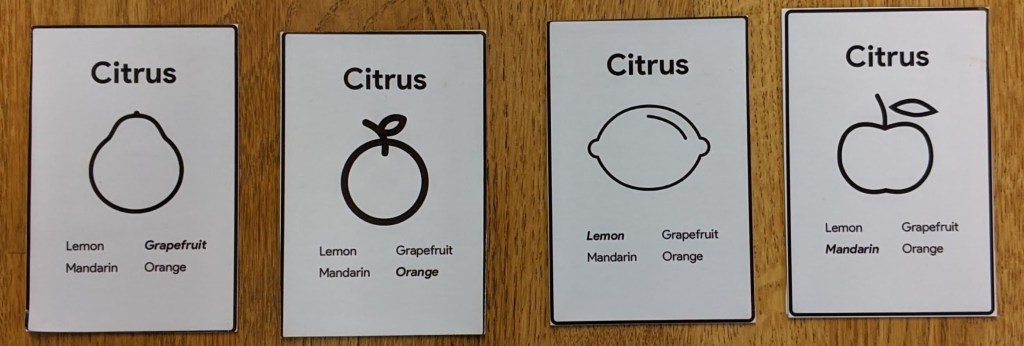
The second level is almost the same, the biggest difference is that the visual confirmation is missing. The only check that exists is in the form of a QR code. As soon as a player thinks he has a quartet, the codes of these cards are scanned to check whether these cards have been correctly identified. Once all cards have been correctly identified and all four fall within the same category, the player has a quartet.

The first level therefore serves more as an introduction to the second level. The second level was our original idea, but after the seminar it seemed logical to incorporate the first level. The second level also fits in well with the article: “Beyond Smell-O-Vision: Possibilities for Smell-Based Digital Media” (Jonas K. Olofsson et. all, 2017). It concludes that games that only focus on smell develop our cognitive capacities better than a combination of visual and smell.
We wanted to make the prototype itself as simple as possible in order to focus on the smell. Mainly in the second level the playing cards only consist of an icon to indicate where the scent is and the QR code.
The final presentation went quite smoothly. The concept was clear and the steps we had taken in our design process were logical. The only thing that could be better about the presentation itself was the explanation about the original game “quartet”. The majority of the class was not familiar with the game. Perhaps it would have been useful to give a brief demonstration of the original game. So the step towards explaining our concept went more smoothly.
All in all, I am very satisfied with this week. And I will definitely use smell in my design process in the future, if the opportunity arises.
 Sitetitel