23.11
This week started again with a presentation on the topic of the week. The topic that is now being discussed is Data Physicalization. This is a variant of data visualization. But what is the difference between these two? The goal of data visualization is:
“the use of computer supported, interactive, visual representations of
abstract data to amplify cognition (thought).”
Meanwhile, advances in tangible computing have illustrated how humans can interact with digital information by using their natural ability to perceive and manipulate physical objects and materials.
As such, a research area has emerged that questions why the display of, and interaction with, data should remain limited by the constraints of pixel matrices, two-dimensional gestures and keyboards buttons, and whether moving data representations from flat displays into the physical world could create novel and useful ways of exploring, experiencing and communicating data.
Data physicalization is therefore a way of visualizing data in a three-dimensional way in which the use of multiple senses plays a big role. Of all the subjects that we will be going through this course, I have the least prior knowledge about this subject. I have often made data visualizations but I have never heard of this topic.
And for the presentation I therefore had little interest in this subject. Because my image of data visualizations provoke little to no interaction. But after the presentation my opinion on this subject changed completely. This way of presenting data actually provokes interaction. And it also gives a designer a lot of freedom to think creatively.
The brief we received for the project that we have to complete before Friday
We have also been told what we have to do by Friday. We must first choose a topic that we consider important as a team. For example: Sustainability, Diversity, Design process or something similar. And make a data physicalization from that topic that both informs and provokes.
There four design principles that this data physicalization must meet.
- Unity:
The concept needs to include both information and provocation in a single physical product. - Coherency
The concept needs to be coherent as a whole. The forms, behaviors, colors, etc. of information and provocation need to be in harmony with each other. - Contextuality
The concept needs to be contextual. It needs to be designed for, and be suitable for a specific place. (e.g. home, city, school, airport, etc.) - Durability
The concept needs to be sustainable. It needs to have aesthetical and functional values that last in time.
After the presentation I read the articles. At first glance, the articles did not seem too difficult at all. They are fairly short and they are easily written. But I soon realized that they were quite substantive. A lot of information is shared in short pieces and the information varies considerably. There is also a fairly large time difference between the articles, which means that the subject is looked at in a completely different way.
We also started a first brainstorming session with the team on the topic we want to choose. And after brainstorming for a while we came across the subject: “language”. And especially how identity is linked to language. Everyone in our team grew up with a different language and this is linked to steriotypes. This can be positive or negative. But no matter how you look at it, language is part of our identity. And language is always intertwined with another language. What in turn ensures that identities are intertwined.
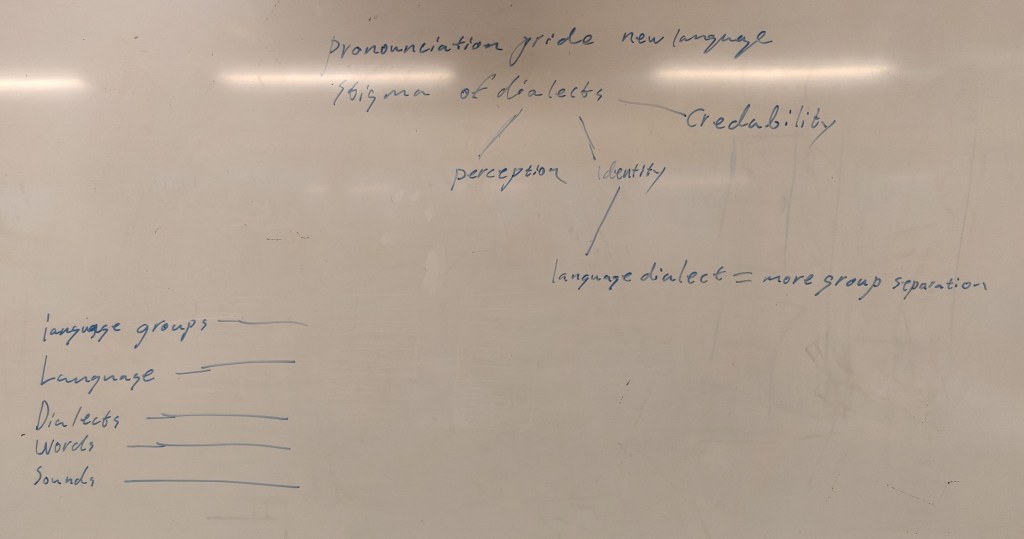
Unfortunately it was not possible to find enough data about language, but we did find data related to dialects. What we found even more interesting. You can speak the same language and still have prejudices because someone speaks the language slightly differently.
Tomorrow we want to take a good look at the data and think about how we can physicalize this.
 Sitetitel